Anyone who passes by New Bedford Research & Robotics’ (NBRR) campus can tell a lot is happening at 1265 Purchase Street, both inside and out. On any given day you can witness the buzz of activity that makes NBRR’s ecosystem tick. Simply put, it’s dynamic. Here you’ll find start-ups gearing to launch, the public engaging through community events, STEAM classes designed to inspire and workforce development programs helping transform the futures of those who call the South Coast home.
NBRR is a proud partner in supporting the region’s training initiatives, using its expertise and resources to help usher in the workforce of the future. And there’s nothing more futuristic than humans and robots, working collaboratively to solve problems and improve processes. That’s just what NBRR set out to do when it created its Workforce Development Program in Industrial Robotics.
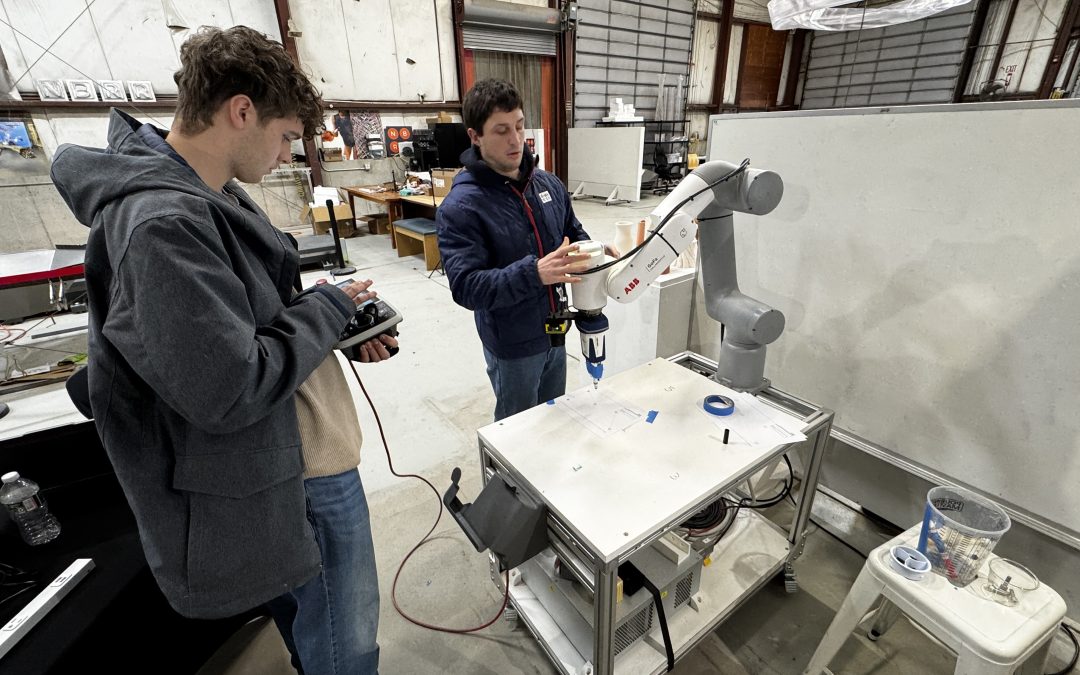
NBRR’s program employs a ‘Full-Stack Robotics’ philosophy, one that’s very different from your traditional, siloed vocational training. Here, participants get hands-on experience working with Cobots (collaborative robots) and industrial arms; they learn advanced toolpathing, develop programming skills and gain experience with metal forming, large-scale 3D printing and digital fabrication. As lead Industrial Robotics Instructor, Dishant Patel knows, this training is a win for participants and employers alike. “Completing a high-level robotics workforce program, especially one that emphasizes full-stack robotics, positions participants as ‘polymaths’ in a modern labor market that’s starving for hybrid talent.”
Patel, an industrial robotics and mechanical engineer, specializes in computational design and digital fabrication. Translating his level of expertise to participants, who may have little prior knowledge of robotics, is no easy feat. It takes skill and patience, and Patel is certainly up to the task. “What I find most rewarding is demystifying these ‘high-barrier’ technologies and witnessing the ‘aha’ moment when a student successfully translates a digital design into a physical, robotic reality. It’s a bridge of sorts.”
That curiosity and desire to bridge those worlds is what brought Industrial Robotics graduate, Hugo Barreira, whose background is in technology and digital art, to NBRR. When he reflects on the skills he learned in the program, Barreira describes how he “gained a deeper understanding of robotics and their incredibly broad applications—from additive manufacturing and multi-material 3D printing to remote operation and fully autonomous programmed tasks.”
That tracks with what Patel sees as the advantages of NBRR hosting the Industrial Robotics program, which benefits from the organization’s unique ecosystem. NBRR operates at the intersection of a research lab, a fabrication shop and a design studio. “Participants aren’t just learning to operate a machine for a repetitive factory task; they are learning adaptive fabrication,” says Patel.
An important aspect of the program is ensuring learners have a variety of experiences to pair with the hands-on learning. Since soft skills are so essential to success in any workplace, they’re incorporated into the curriculum as well. There’s a lot of group work, which hones everything from listening to problem-solving and leadership skills. “When participants collaborate to help solve each other’s queries and troubleshoot bugs in the code they’ve written, they figure out how to work together as a team,” says Co-Instructor, Neehal Sharrma.
Because of its staff expertise, facilities and location, NBRR is uniquely positioned to offer relevant and comprehensive training. Specific to its program is “the exposure we give to other emergent technologies that NBRR specializes in, such as metal forming, sand casting, and thermoplastic/ceramic extrusion manufacturing,” says Sharrma.
Its breadth of human and technological resources is what makes NBRR a key player in fostering regional economic growth, filling skills gaps and supporting industries like the Blue Economy and offshore wind. NBRR understands that when you enhance local competitiveness, upskill workers, and connect those who are unemployed with emerging job opportunities, it makes the regional economy that much stronger. And it’s a problem that NBRR is proud to help solve through its workforce development initiative.
Training opportunities like the Industrial Robotics Program can transform people’s lives by not only opening up professional pathways but by letting them see what they are capable of. Workforce graduate, Hugo Barreira knows this firsthand. When asked what advice he’d give to someone considering the program, Barreira advises that they “be ready, stay open-minded, and don’t be afraid to come out of the experience as a different version of yourself. Your mind will thank you for it.”
–––––––––––––––––
Want to know more?
To learn more about NBRR and its Workforce Development Program, check out this link.