
Intern Spotlight: Jack (Intern 2023–2025)
Schooling: Candidate BA, Computer Science, Hamilton College
How has your role as an NBRR intern evolved since you started?
After 3 years of interning at NBRR, my role has changed a bunch. During my first year, we were still in temporary space downtown, and my focus was on getting the clay printing up and running. While it wasn’t my area of expertise I enjoyed the engineering process and getting to write small code snippets that improved print accuracy and speed. My second year we moved into the NBRRs facility at 1265 Pleasant Street, a much larger space with more robots. That’s when I got to work more on computer science-specific tasks like computer vision (coding). Along with another intern, I wrote a library of methods to instruct the GoFa robot and onboard camera to “talk” to each other so that the robot could automatically detect objects and move them around.
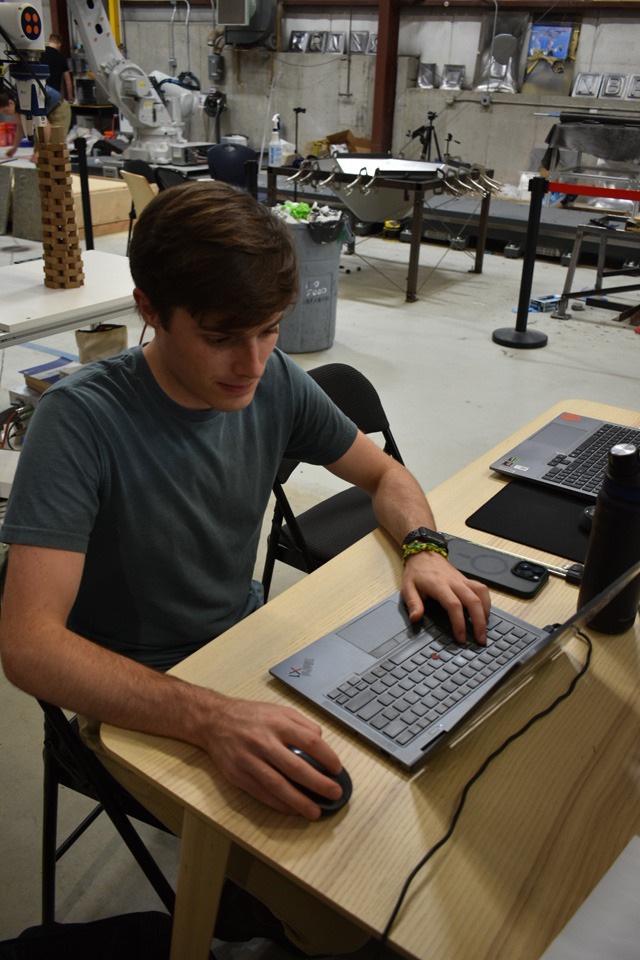 The third year has involved a deeper application of my computer science skills as I work with other interns to automate tasks. Right now we’re creating an underlying AI workflow to aid in our manufacturing processes. This will enable the work being done with the robots to be more efficient, predictable and reliable. The current goal is to have the foundational AI detect issues and fix them before they show up in production. Our more distant goal is for the AI program to have a dual use. It’ll be an intelligent helper for the engineers while also being capable of assisting someone like a student or an entrepreneur who may have an idea for something to create but not the technical background necessary to design or manufacture it. That’s where the AI will serve as a guide, directing users through a technical process or doing it for them automatically.
Can you speak to the real world applications of what you’ve learned in your Computer Science studies at Hamilton to your intern work at NBRR?
I think my strong background in math and my logic and problem-solving capabilities have allowed me to work through computational tasks more efficiently and effectively. Because of the algorithm courses that were part of my program, I was able to make the computer vision routines from last summer more efficient. And after spending a semester in Copenhagen, where I recently completed a machine learning course, I’ve been able to directly apply that experience to the AI project I’m currently working on.
What NBRR activities/events have you been involved in as an intern?
I help out at the monthly New Bedford AHA! Nights when the NBRR facility is open for public programming. I also assist the STEAM staff with the summer intensives for high school students as well as with the younger students from Nativity Prep. Working with all these different groups requires a lot of flexibility and adaptability and has been a good way to get more experience with public speaking and teaching.
Can you talk a little about your experiences with success, failure and risk taking?
The hallmark of good research is uncertainty, and everything I work on involves uncertainty. You’ll always run up against a lot of roadblocks, and that’s to be expected. For instance, the AI workflow we’re creating is not as accurate as we want it to be just yet, but that’s part of the problem to be solved. In my research experience here and outside of NBRR I’ve tried to redefine my success metric. I ask myself: Did I try something new and did I learn something from it? As long as I’ve tried something new and learned from it, it’s a success. Eventually, I’ll learn something that helps me take a step towards making the project work. And when it does finally work, it’s great.
What skills have you developed through the NBRR Internship Program?
There’s a lot of diversity to the experiences I’ve had as an intern over the last 3 years. As I mentioned, I’m constantly problem solving, which is very important in my field. I’ve also learned about the hands-on aspects of computer science like electronics, hardware integration, robot specific programming quirks, and programming languages made for specific robots that we use at NBRR. I’ve also gotten to collaborate a lot, whether that’s on a project or an event or during an educational activity.
The last three years have really expanded my technical skills too in areas such as RAPID programming, 3D modeling, 3D printing, machine vision, metalworking, 6-axis coordinate programming, large scale additive manufacturing, RobotStudio software, and machine learning. I’ve also gained more experience with research methods and project management.
What skills did you learn that you hadn’t anticipated?
I work with the public a lot during the programming for AHA! Nights. I didn’t expect to interact with so many people who walked in off the street and didn’t know anything about robots. I found that I liked explaining the projects and helping people understand what we were doing. It was so much fun seeing how excited they got. And as a result I realized that teaching is something I might want to do after grad school.
What do you hope to do when you graduate and how do you think the work you’ve done as an intern at NBRR will help you reach those goals?
I’m hoping to pursue a Ph.D. in robotics and automation, so the experiences I’ve had at NBRR have been invaluable. There’s not many places where you can work with industrial robots as an undergrad. The fact that I can operate an ABB robot is really valuable to employers and research institutions and my internship experience shows that I can successfully problem solve, implement scripts, algorithms, and libraries, and effectively collaborate with people from a broad range of technical backgrounds.
What advice would you give a new intern?
Be open to getting on a project for something that you’d never done before and be open to learning new things, taking advice, getting comfortable talking to new people, and diving headfirst into any problem thrown your way.
What one word would you use to describe your NBRR internship experience?
Exploration–exploring what’s possible.